CARTRIDGE 60% Polarmain BIOMETRIC DIFFUSION
P3 — Speculative Product Design

Polarmain
Biometric
Diffusion

A research-driven wearable concept that reads your body's stress signals and responds with precision-dosed scent — calm delivered at the moment you need it most.

Category
Speculative Product Design
Disciplines
Product Design · Wellness Strategy · Wearable Tech · Material Research
Research Phase
Expert Consultations · Primary Research · Concept Iteration
Status
Early-Stage Concept — Research Complete
Overview

A Necklace That
Reads Your Calm

Polarmain is a speculative product concept born from a simple question: what if your body could trigger its own aromatherapy? The device is a wearable diffusion necklace that monitors heart-rate variability (HRV) as a proxy for stress state, and responds by releasing a calibrated micro-dose of therapeutic scent — privately, precisely, and exactly when the body signals that it needs support.

Unlike traditional diffusers, which broadcast scent into an environment indiscriminately, Polarmain is personal and responsive. The wearer decides the scent profile; the device decides the moment.

This project was treated as a serious early-stage product exploration from day one — not a sketch exercise, but a disciplined research process involving expert consultation, safety review, and iterative concept refinement grounded in real engineering and aromatherapy constraints.

Polarmain CONCEPT
Research Foundation

Five Disciplines,
One Design Question

The research phase was extensive and interdisciplinary — each domain surfacing constraints, opportunities, and design requirements that directly shaped the concept.

01 — RESEARCH DOMAIN

Aromatherapy Safety

Established safe dosage thresholds for skin-proximate diffusion, dermal absorption risks, and which essential oil categories are appropriate for continuous low-level exposure.

02 — RESEARCH DOMAIN

Olfactory Response

Studied the neuroscience of smell — how quickly scent molecules reach the limbic system, the role of habituation, and how scent fatigue affects therapeutic efficacy over time.

03 — RESEARCH DOMAIN

Heart-Rate Variability

HRV is a validated biomarker for autonomic nervous system state. Research identified minimum sensor accuracy requirements and established HRV thresholds that would trigger a diffusion event.

04 — RESEARCH DOMAIN

Wearable Sensors

Evaluated optical PPG sensors for HRV measurement at the necklace position (sternal or clavicular), assessing accuracy tradeoffs versus wrist-based measurement.

05 — RESEARCH DOMAIN

Emotional Regulation

Framed the product within evidence-based emotional regulation frameworks — understanding when scent intervention is helpful, and when it risks masking rather than addressing stress.

06 — SYNTHESIS

Safety Constraints

Defined hard constraints from the research: maximum diffusion duration, minimum inter-diffusion intervals, cartridge isolation requirements, and skin-safe material specifications.

Expert Consultations

Grounded in
Real Expertise

Three expert domains were consulted to pressure-test the concept against real-world engineering and safety constraints.

Engineering Faculty

Feasibility Review

Consulted on miniaturization constraints for the diffusion mechanism, power budgeting for a coin-cell battery system, and the viability of micro-pump or piezoelectric diffusion at the required dosage scale.

Aromatherapy Specialists

Therapeutic Protocols

Advised on scent selection for stress modulation, session duration recommendations, and how to structure a cartridge system that supports genuine therapeutic outcome rather than preference alone.

Biometric / Wearable Tech Experts

Sensing Architecture

Evaluated sensor placement, signal quality at non-wrist body positions, real-time HRV computation requirements, and the edge-processing needed to make biometric-triggered diffusion responsive without latency.

Internal Architecture

What Lives
Inside the Pendant

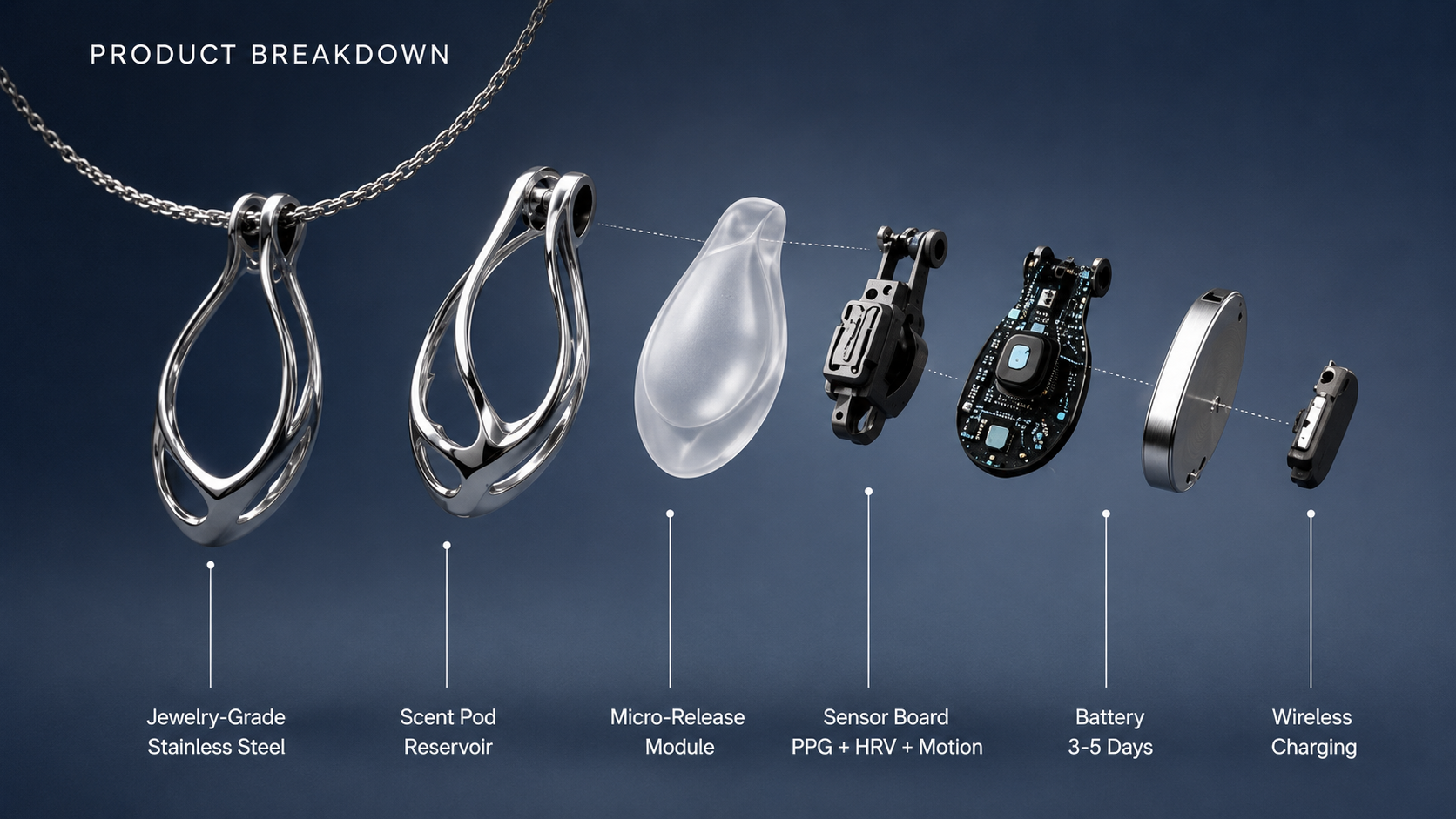
The pendant is designed to be compact enough to wear as jewelry, with all active components housed within a form factor no larger than a standard pendant locket. The architecture is deliberately modular — the scent cartridge is user-replaceable, the sensor module is calibratable, and the interface is minimal by design.

PPG Sensor
Optical photoplethysmography sensor positioned at the sternal notch, capturing blood volume pulse for real-time HRV computation.
Validated
MCU
Low-power microcontroller handling HRV algorithm, diffusion trigger logic, and BLE connectivity for companion app sync.
Feasible
Micro-pump
Piezoelectric micro-pump draws scent from a sealed cartridge and forces it through a mesh diffuser face — silent, controllable, and low-power.
Prototypable
Scent Cartridge
Sealed, user-replaceable cartridge containing a carrier-suspended essential oil blend. Carbon-sealed to prevent passive off-gassing when device is inactive.
Validated
Power Cell
Rechargeable thin-film lithium battery. Target: 3 days between charges at average use (2–3 diffusion events per day, 3–5 minutes each).
Under Review
Key Design Decisions

Every Choice Has
a Reason

Decision 01

Necklace, not wristband

Proximity to the nose matters for olfactory efficacy. A pendant sits 20–30cm from the nasal passage — close enough for targeted delivery while avoiding skin-contact diffusion risks. A wristband would require significantly higher scent intensity to achieve equivalent effect.

Decision 02

HRV trigger, not manual

User-initiated diffusion exists as a fallback mode, but the primary interaction is biometric. Removing the manual decision from the loop addresses the core UX problem: people under stress often don't realize they need support until after the moment has passed.

Decision 03

Replaceable cartridge system

Rather than a fixed reservoir, Polarmain uses a cartridge-based system. This enables scent personalization, prevents cross-contamination between blends, and creates a sustainable business model aligned with the therapeutic protocol (rotating scent to prevent habituation).

Decision 04

Minimal physical UI

The device surface exposes a single mode button and one status light. All configuration — scent scheduling, HRV sensitivity, diffusion duration — happens in a companion app. The pendant itself should disappear into the wearer's day.

The most interesting design problems live at the edge of what's technically possible and what a person's body actually needs.

Polarmain pushed me to design for constraint — where the body's safety requirements, engineering minimums, and therapeutic protocols all had to coexist within something small enough to wear as jewelry. That tension between precision and warmth, between clinical rigor and personal meaning, is exactly where I want to keep working.